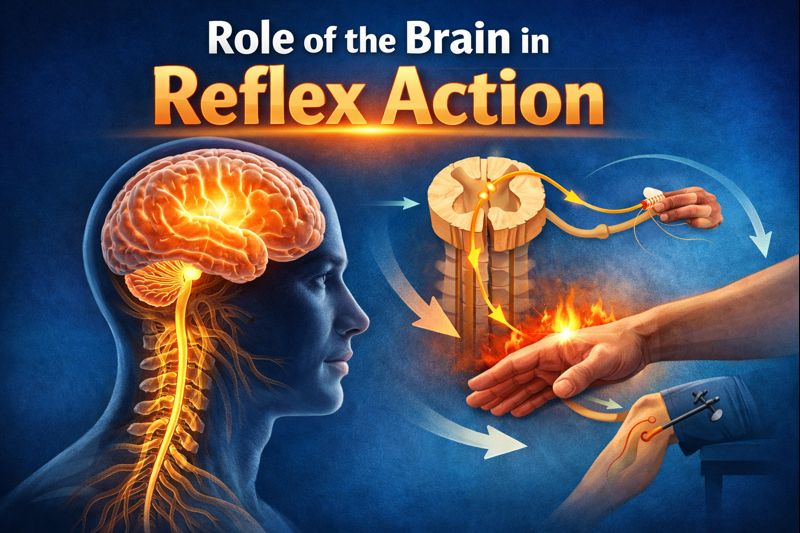
Reflex actions are rapid, automatic responses of the body to a sudden stimulus. They play a crucial role in protecting the body from harm and maintaining balance in daily activities. Understanding what is the role of the brain in reflex action helps explain how the nervous system ensures quick reactions without conscious delay.
This article explains the mechanism of reflex action, the involvement of the brain, and how reflexes differ from voluntary movements, using simple and clear language.
Understanding Reflex Action
A reflex action is an involuntary and immediate response to a stimulus, such as pulling your hand away from a hot surface or blinking when something comes close to your eyes. These actions occur without conscious thinking, allowing the body to react instantly to potential danger.
Reflexes are controlled by the nervous system and follow a specific pathway known as the reflex arc.
What Is a Reflex Arc?
The reflex arc is the neural pathway followed during a reflex action. It consists of:
Receptor – detects the stimulus (heat, pain, pressure)
Sensory neuron – carries the signal to the spinal cord
Interneuron – processes the signal within the spinal cord
Motor neuron – sends the response signal
Effector – muscle or gland that performs the action
This pathway ensures that the response is fast and efficient.
What Is the Role of the Brain in Reflex Action?
The brain does not directly control most reflex actions, but it still plays an important supportive role.
Key roles of the brain in reflex action include:
Receiving information after the reflex occurs Although the reflex is initiated by the spinal cord, the brain receives sensory information shortly after, allowing you to become aware of what happened.
Modifying reflex responses The brain can enhance or suppress certain reflexes based on experience, learning, or context. For example, trained athletes may show controlled reflex responses.
Coordinating complex reflexes Some reflexes, such as balance and posture-related reflexes, involve higher brain centers like the cerebellum and brainstem.
Integrating reflexes with voluntary actions The brain helps align reflex actions with conscious movements, ensuring smooth coordination.
In short, while the spinal cord controls reflex action, the brain supervises, interprets, and refines the response.
Why Doesn’t the Brain Control Reflexes Directly?
If every stimulus had to be processed by the brain first, the response time would be slower. Reflex actions bypass the brain initially to:
Prevent injury
Save time in emergencies
Ensure survival-oriented responses
This design allows the body to react in milliseconds.
Examples of Reflex Actions Involving the Brain
Withdrawal reflex (pulling hand away from heat) – brain receives pain information after action
Knee-jerk reflex – spinal cord controlled, brain evaluates muscle tone
Blink reflex – involves the brainstem
Postural reflexes – coordinated by the cerebellum
Difference Between Reflex Action and Voluntary Action
Reflex Action
Voluntary Action
Involuntary
Conscious and intentional
Very fast
Relatively slower
Controlled by spinal cord
Controlled by brain
Automatic response
Requires thinking
Importance of Reflex Actions
Reflex actions are essential for:
Protecting the body from injury
Maintaining posture and balance
Supporting normal neurological function
Detecting nerve or spinal cord disorders during clinical examinations
Doctors often test reflexes to assess the health of the nervous system.
FAQs
1. Is the brain involved in reflex action?
Yes, the brain is involved indirectly. While the spinal cord initiates the reflex, the brain receives and processes the information afterward.
2. Which part of the nervous system controls reflex actions?
Most reflex actions are controlled by the spinal cord, not the brain.
3. Can reflex actions be controlled by the brain?
Some reflexes can be modified or suppressed by the brain with practice or conscious effort, but they cannot be completely eliminated.
4. Why are reflex actions faster than voluntary actions?
Reflex actions bypass conscious brain processing, allowing quicker responses through the spinal cord.
5. Are all reflexes controlled by the spinal cord?
No. Some reflexes, such as blinking and balance reflexes, are controlled by the brainstem or cerebellum.
Disclaimer
This content is for informational and educational purposes only and should not be considered medical advice. For concerns related to neurological health or abnormal reflexes, consult a qualified medical professional.